How Tactful runs discovery
Know who said what, where, and whether it's verified.
One markdown checklist for your whole discovery, fed by live interviews, call transcripts, emails and client questionnaires.
## 3. Backups

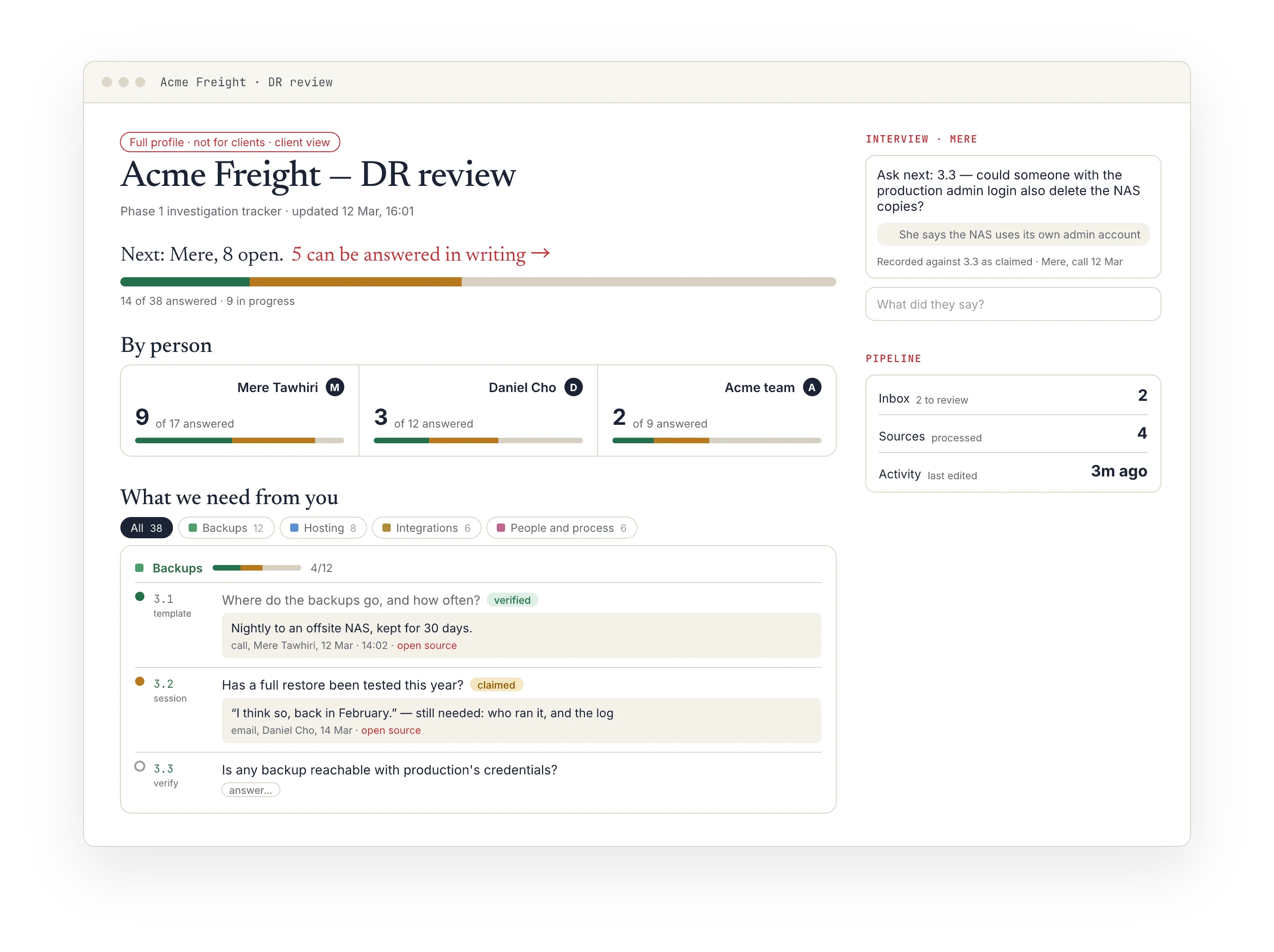
- [x] `3.1` **S** Where do the backups go?
    - **Answer:** Nightly to an offsite NAS, 30 days.
    - **Source:** Mere, call 12 Mar, 14:02
    - **Status:** verified

- [/] `3.2` **S** Has a restore been tested?
    - **Answer:** “I think so, in February.”
    - **Source:** Daniel, email 14 Mar
    - **Status:** claimed

- [ ] `3.3` **T** Recovery time for finance?
The problem
Discovery stalls on one question: who said what, where, and is it verified?
- 01Answers get lost between calls.
- 02Nobody can tell a claim from a checked fact.
- 03The client never sees what they still owe.
How it works
Everything feeds one checklist.
Ask
The copilot suggests the next question, one at a time, in plain conversational wording.
Capture
Answers arrive from live calls, transcripts, emails, voice memos and client questionnaires.
Approve
You tick through a diff of proposed changes. Nothing is written until you say so.
Verify
A claim someone checked independently is marked verified, cited to its source line.
Features
One tracker, fed from every conversation.
What Tactful uses on every discovery engagement, from the first call to the findings.
Interview copilot
Picks the next question, judges the answer against a bar, and writes it to the tracker while you talk.
Inbox with approval
Drop in a transcript, email or voice memo. Tick through the proposed changes before any land.
Claimed vs verified
Every answer keeps its source. Nothing counts as verified until someone checks it.
Written questionnaires
Each person gets a private link for what they can answer in writing. They never see your findings.
Findings as you go
Risks logged the moment they turn up, with a severity and a likely fix.
Both sides transcribed
Calls recorded and transcribed live, tuned to the client's own system names.
The tracker
See each answer, its source, and who still owes you what.
Privacy and trust
Your client's information stays where you put it.
Discovery touches sensitive systems. The tool is built so you can show a client exactly where their answers live.
- Plain markdown in your own folder
The checklist is a plain markdown file in a folder you control.
- One isolated site per client
Each engagement runs on its own, so one client's answers never sit alongside another's.
- Credentials refused and redacted
If a password or key turns up in a transcript, email or answer, it's refused and redacted everywhere.
- Every change audited
Each change is logged, can be undone, and is cited back to the line of the transcript or document it came from.
- Clients see progress, not findings
The shared page shows what's done and what they owe. Never your findings or notes.
See how this could work for you.
Leave your email and a line about the systems you need to understand. We'll write back.